

Quick Summary
Decorating rental apartments without losing your deposit starts with reading your lease and photographing each room on move-in day. Then add removable wall art, layered lighting, and textiles, and keep every change reversible.
- Read the lease for alteration and wall damage clauses before buying anything.
- Photograph every room, wall, and fixture on move-in day as a record of original condition.
- Measure walls, windows, and floor space before buying rugs, shelves, or sofas.
- Split the decorating budget roughly half into movable items and a third into mid-range pieces.
- Remove decor in reverse order at move-out and patch small holes with spackle.
Table of Contents
- Start With a Lease Check and a Plan for Your Rental Apartments
- Step 1: Dress Up Bare Walls With Removable Wall Art
- Step 2: Layer Lighting and Textiles in the Living Room
- Step 3: Add Plants, Pillows and Small Accents Room by Room
- Budget Tiers and Realistic Costs for Decorating Rental Apartments on a Budget
- Restore the Space Before Move-Out: How to Make a Rental Apartment Look Good Without Losing Your Deposit
- Frequently Asked Questions
Start With a Lease Check and a Plan for Your Rental Apartments
Last Updated: November 2, 2026
Giftness Decor has a practical plan for renters who want a space that feels like home without risking the deposit. The right order matters more than the purchase itself.
Many landlords restrict nails, paint, and permanent fixtures, but rules vary. Check the lease for wording on alterations, wall damage, and move-out condition, and ask the landlord in writing if anything is unclear.
Photograph every room as you move in. These photos can serve as a record of the original condition.
Then sketch a simple plan noting wall space, window positions, and outlets. A rough floor plan keeps you from buying a rug that's too big or a sofa that blocks the only path to the kitchen.
Watch out: Measure before you buy. A rug or shelf that looks right online often overwhelms a small room once it arrives.
Quick checklist before you start:
- Read the lease for alteration and damage clauses
- Photograph every room, wall, and fixture on move-in day
- Measure walls, windows, and floor space
- Set a total budget and split it across rooms
- List the items you plan to use, and check each one for removability
Step 1: Dress Up Bare Walls With Removable Wall Art
Bare walls are the fastest way to make a rental look unfinished. Removable wall art solves that without touching the paint, and every piece can come down cleanly at move-out.
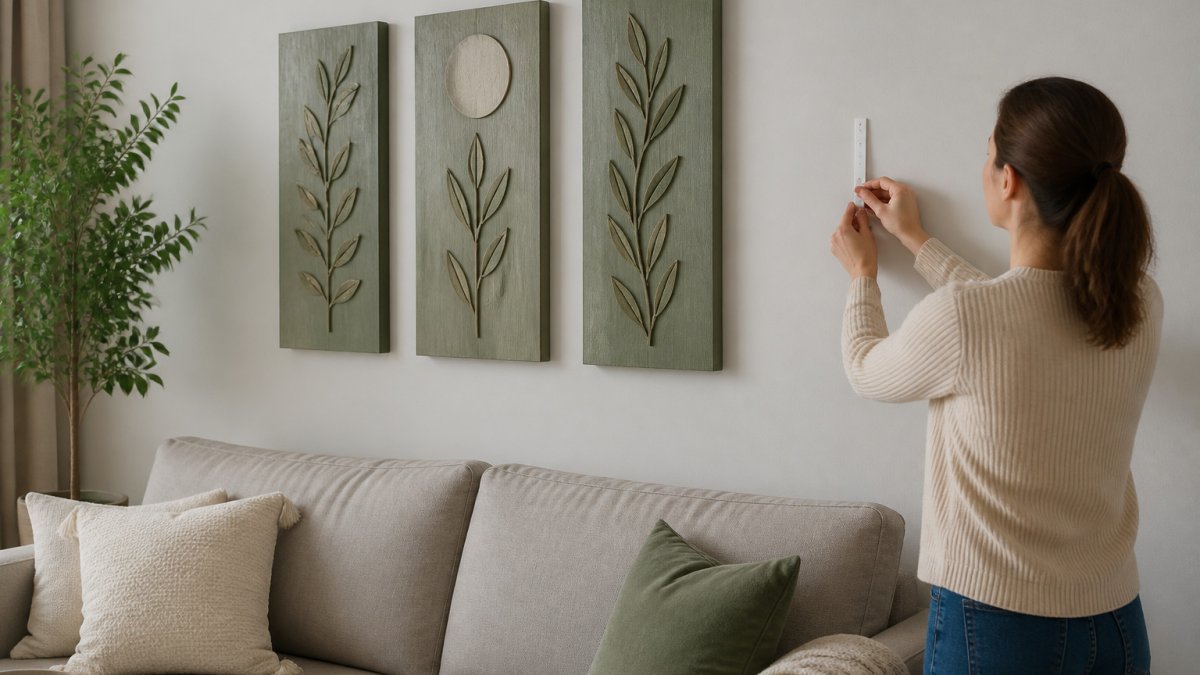
Start with a statement grouping above the sofa or bed. The Sage Green Wood Wall Art Set of 3 gives you three coordinated panels.

For a softer, more minimalist option, the Metal Flower Wall Art Set of 4 offers a line-art botanical composition. You can arrange the panels side by side or spread them across a longer wall.

Renters often ask whether they can hang art without damage. It depends on weight and wall type, so use the lightest mounting method that holds your piece securely.
Watch out: Adhesive strips can pull paint off textured or freshly painted walls. Test one spot in a closet first.
Where to start on bare walls:
- Hang one large piece above the main seating or bed
- Group smaller pieces in threes for a balanced look
- Keep a 2-3 inch gap between frames for a cohesive display
- Hang art at eye level, about 57 to 60 inches to the center
Step 2: Layer Lighting and Textiles in the Living Room
Lighting changes the feel of a rental more than almost any other update. Harsh overhead fixtures make even nice furniture look flat. Layering a few light sources creates warmth without any wiring work.
A plug-in wall light can add ambient glow without hardwiring. The Modern LED Wall Light comes in 80 cm and 100 cm sizes, with a black finish and soft ambient LED lighting.
Textiles do the rest of the work. A round velvet throw pillow adds texture and color to a sofa or reading chair. The Round Velvet Throw Pillow measures about 35 cm across, has a hidden zipper, and is available in 6 colors.

Layering also means mixing heights. Combine a floor lamp, a table lamp, and the wall sconce so the room has light at several levels. Add a throw blanket over a chair arm to finish the look.
Living room layering basics:
- Use three light sources at different heights
- Choose warm bulbs in the 2700K range for a cozy feel
- Pick pillows in two or three colors that repeat existing tones
- Keep the largest textile, such as a rug or throw, in a neutral shade
Step 3: Add Plants, Pillows and Small Accents Room by Room
Small accents are where a rental starts to feel personal, but the mistake most renters make is buying accents room by room without a plan for how each room functions.
Start with measurements, because accent pieces fail most often on scale.
Then work room by room using a simple plan that fits rental layouts:
Studio or open-plan rental: Use accents to create zones rather than fill space. A low shelf or a pair of bookends can mark the edge of a work area without building a wall. Keep planters on the floor or on a tray near the window, repeat one color or material across zones, and avoid tall accent pieces in the middle of the room where they block sightlines.
Sage Green Wood Wall Art Set of 3, Modern Abstract Panels, Neutral Home Decor →
Shared or multi-use rooms: Choose accents that are easy to move and hard to break. Ceramic planters with drainage trays can help with water management, and bookends keep shared shelves tidy.
For plants, match the plant to the light you actually have. Choose plants that suit the light you have, and check each plant's light needs before placing it.
For shelves and desks, use the rule of three: group objects in odd numbers, vary the heights, and leave some empty space.
Watch out: Water can leave marks on wood and laminate, so set plants on a tray, especially when you use a planter without a drainage tray.
Room-by-room accent checklist:
- Entryway: one small vase or planter on a console that clears the door swing
- Living room: one anchor accent plus a plant, kept out of main walkways
- Bedroom: a plant on the nightstand and one small object on the dresser
- Home office: bookends, a desk plant, and one figure, leaving clear desk space
- Studio: repeat one color or material across zones instead of adding more pieces
Budget Tiers and Realistic Costs for Decorating Rental Apartments on a Budget
A rental makeover does not need a large budget, but it does need a plan.
Set tiers by function rather than brand. Low-cost items change a room's feel for little money and are easy to move: pillows, throws, planters, small vases, bookends, and a few plants.
One approach is to put roughly half of the budget into lower-cost items, a third into mid-range pieces, and the rest into a single larger piece.
Prioritize in this order:
- Lighting and textiles first. A plug-in lamp and a rug or throw do more for a room than any wall accent, and both move with you.
- One wall anchor per main room. Choose a single art piece or set for the wall above the sofa or bed rather than spreading small pieces across every wall.
- Plants and small accents last. These are the cheapest items and the easiest to add over time, so they should not consume the early budget.
- One splurge piece, placed where it counts. Put it in the room you use most, not in a hallway or a room guests rarely see.
A common pattern among renters is to buy a full matching set before knowing the layout, then discover half of it doesn't fit.
Watch out: A low headline price can hide the cost of mounting hardware, adhesive strips, spackle, and touch-up paint, so consider a small restoration budget before you spend the decorating budget.
Budget strategy tips:
- Set a total budget and split it across rooms before you shop
- Put roughly half into low-cost, movable items and a third into mid-range pieces
- Buy one anchor piece first and add accents over several months
- Keep a small restoration fund for strips, spackle, and touch-up paint
- Reuse and rearrange what you own before buying anything new
The article suggests splitting a rental decorating budget into tiers, roughly as follows.
| Tier | Typical items | Share of budget |
|---|---|---|
| Lower-cost, movable | Pillows, throws, planters, vases, bookends, plants | About half |
| Mid-range | Wall art set, plug-in wall light, floor lamp, rug, shelving | About a third |
| Splurge | One large vase, mirror, armchair or quality rug | Remainder, one piece |
Restore the Space Before Move-Out: How to Make a Rental Apartment Look Good Without Losing Your Deposit
Move-out is where many renters lose money, so plan the removal as carefully as the setup.
Remove wall art first. Pull adhesive strips slowly to reduce the chance of pulling paint.
Next, remove lighting and plug-in fixtures. Disconnect cords, take down mounting hardware, and patch any holes. Keep the original hardware if your landlord requires you to reinstall the previous fixtures.
Clean up plants and planters last. Move plants outdoors or to a new home, and wipe down the shelves underneath to remove water rings.
Finally, compare the room to your move-in photos. Walk through each room with the same angles you used on day one. If you see marks you missed, fix them before the final inspection.
Keeping decor reversible from the start can help you manage your deposit. Choose pieces you can remove, patch small holes when needed, and document everything.
Frequently Asked Questions
What is the 3-5-7 rule in decorating?
The 3-5-7 rule is a styling guideline for grouping decor: arrange items in odd-numbered sets of three, five or seven, which tends to look more natural than pairs. In a rental, apply it to shelf vignettes, such as a bird ornament, a bookend pair and a small planter, or to a cluster of cushions on a sofa. Because the grouping relies on objects you can move, you can rearrange the whole display in minutes when you move out, without touching the walls.
How can I decorate a rental apartment without damaging the walls?
Start with reversible tools: removable adhesive strips rated for your wall type, tension rods for curtains, and freestanding pieces like sculptural vases, bookends and floor planters. Hang wall art on a single picture hanging strip rather than a nail, and check the strip's weight rating before you hang anything heavy. Test any adhesive on a small hidden area first. Freestanding decor and textiles can add visual interest without fixed mounting.
What are the best budget-friendly ways to decorate an apartment?
Consider starting with one wall art set, a throw pillow or two, and a lamp or wall sconce. Then add low-cost pieces such as a single plant in a ceramic pot. Splitting your budget into tiers helps: a starter tier for one room, a refresh tier for a second room, and a finishing tier for accents. Shop one room at a time so you can judge each purchase in place before buying more.
How can I make a small rental apartment feel cozy?
Use warm, layered light instead of a single overhead fixture. A wall sconce or lamp at seated height can help create a softer atmosphere. Add a round velvet pillow or a textured throw to a sofa or bed, which adds softness without taking floor space. Keep the palette to two or three tones so the room reads as calm, and place one or two plants near the window to add life.
